Building Reliable Cloud Operations with Modern DevOps Support Services
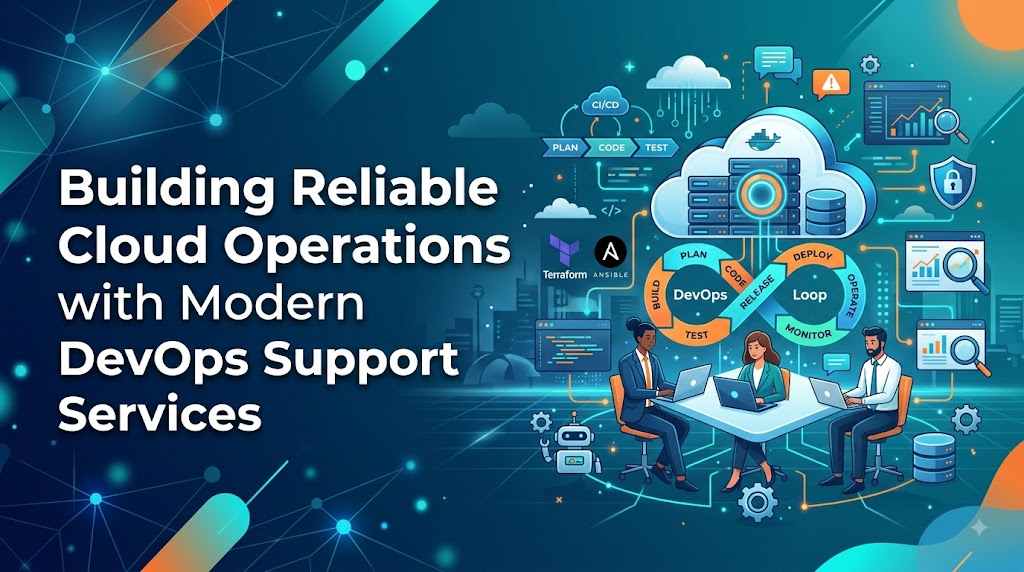
Modern software teams are expected to release applications quickly while keeping infrastructure stable, secure, scalable, and cost-efficient. That combination becomes increasingly difficult as organizations adopt multiple cloud platforms, containerized workloads, automated deployment pipelines, distributed applications, and complex monitoring environments.
This is where DevOps Support Services become valuable. Rather than focusing only on troubleshooting individual technical problems, effective DevOps support helps engineering teams manage the complete operational lifecycle—from infrastructure provisioning and deployment automation to observability, incident response, security, and performance optimization.
For startups, SaaS businesses, enterprises, and cloud-native engineering teams, the goal is not simply to add more tools. The real objective is to build reliable operational processes around those tools. This guide explains how modern DevOps support works, why businesses use it, which technical areas it commonly covers, and how organizations can develop a support model that matches their infrastructure and application requirements.
Understanding Modern DevOps Support
DevOps support is the ongoing technical assistance required to operate software delivery platforms, cloud infrastructure, automation systems, and production environments effectively.
It commonly includes managing CI/CD pipelines, Infrastructure as Code, cloud resources, Kubernetes clusters, monitoring platforms, deployment workflows, security controls, backups, and incident response processes.
Unlike traditional IT support, which often reacts after an issue has already affected users, modern DevOps operations increasingly emphasize prevention. Engineers use monitoring, automated checks, capacity planning, infrastructure policies, and standardized deployment processes to identify weaknesses before they develop into major production problems.
Organizations running continuously available applications may also use 24/7 DevOps Support Services when infrastructure failures, deployment problems, or application incidents need attention outside normal business hours.
Why DevOps Support Matters for Modern Businesses
Technology environments have become more distributed and interconnected. A single customer-facing application may depend on load balancers, databases, APIs, Kubernetes clusters, cloud storage, identity services, monitoring systems, deployment pipelines, and external integrations.
Managing these systems independently can create operational gaps.
A structured DevOps support model helps teams improve several important areas.
Reliability: Monitoring and incident management practices help teams identify failures quickly and restore services systematically.
Deployment efficiency: Automated build, testing, and deployment pipelines reduce manual release activities.
Scalability: Infrastructure automation helps organizations adjust computing resources as application demand changes.
Security: Security scanning, access management, patching, secrets management, and policy enforcement can become part of everyday engineering workflows.
Visibility: Logs, metrics, traces, alerts, and dashboards help teams understand what is happening inside applications and infrastructure.
Operational consistency: Standard procedures reduce dependency on individual engineers remembering manual configuration steps.
When these practices work together, DevOps becomes less about managing isolated tools and more about building repeatable operational systems.
Key Components of Effective DevOps Operations
Infrastructure Automation
Infrastructure automation replaces repetitive manual configuration with reusable code and standardized workflows.
Infrastructure as Code tools allow engineering teams to define cloud networks, virtual machines, Kubernetes resources, security policies, databases, and other infrastructure components through configuration files.
This approach improves consistency because development, staging, and production environments can follow similar configuration patterns.
Automation also makes changes easier to review. Infrastructure modifications can move through version control, testing, approval, and deployment processes similar to application code.
For businesses using Managed DevOps Services, infrastructure automation is often a major operational responsibility because standardized provisioning reduces configuration drift and makes infrastructure easier to maintain over time.
Monitoring and Observability
Monitoring tells teams whether systems are functioning correctly. Observability provides deeper information that helps engineers understand why something is happening.
A mature observability environment normally combines:
- Infrastructure and application metrics
- Centralized logging
- Distributed tracing
- Health checks
- Alerting
- Performance dashboards
- Service-level indicators
- Incident notifications
Collecting information alone is not enough. Alerts should identify meaningful operational conditions rather than generating excessive notifications.
Well-designed monitoring helps engineers investigate problems faster because they can correlate application errors, infrastructure metrics, deployment changes, and user behavior.
This is especially important for SRE Support Services, where reliability management often depends on measurable indicators such as latency, availability, error rates, throughput, and service objectives.
Continuous Integration and Deployment
CI/CD pipelines automate the process of building, testing, validating, and deploying software.
A typical pipeline may include code compilation, automated testing, security scanning, container creation, artifact storage, infrastructure validation, deployment approval, and release execution.
Automation reduces the number of repetitive manual steps developers must complete during software delivery.
However, pipelines also require continuous maintenance. Dependency changes, expired credentials, infrastructure modifications, failed tests, broken integrations, or configuration errors can interrupt releases.
DevOps engineers therefore monitor pipeline performance and continually improve deployment reliability.
Security Integration
Security becomes more effective when it operates throughout the software delivery lifecycle instead of appearing only before production releases.
DevSecOps Support Services can help teams integrate practices such as:
- Static and dynamic security scanning
- Container image scanning
- Dependency vulnerability checks
- Secrets management
- Role-based access controls
- Infrastructure policy validation
- Cloud security configuration
- Audit logging
- Compliance-related automation
The objective is not to slow development. Instead, security checks should become repeatable engineering controls that identify problems early enough for developers to address them efficiently.
Kubernetes Support for Containerized Infrastructure
Kubernetes provides organizations with a powerful way to deploy and operate containerized applications, but its operational complexity increases as environments grow.
Production clusters require ongoing attention to networking, storage, scaling, security, upgrades, monitoring, resource allocation, and workload configuration.
Kubernetes Support Services may therefore cover activities including cluster administration, node management, deployment troubleshooting, autoscaling, ingress configuration, certificate management, backup planning, security hardening, and version upgrades.
For example, imagine a SaaS application experiencing intermittent performance problems during high traffic periods. Engineers may discover that CPU limits are incorrectly configured, causing application containers to restart under load.
Proper Kubernetes monitoring and resource planning can identify this issue and allow the team to adjust requests, limits, and scaling policies before performance problems affect more users.
Supporting AWS Cloud Operations
AWS environments often combine multiple infrastructure and application services.
Organizations may operate virtual machines, serverless applications, container platforms, databases, storage systems, networking services, monitoring tools, and automated deployment infrastructure within the same cloud environment.
AWS DevOps Support Services can help teams manage these interconnected systems while maintaining consistent operational processes.
Common areas may include:
- EC2 infrastructure administration
- EKS and ECS operations
- Serverless workload management
- Terraform or CloudFormation automation
- IAM configuration
- Cloud monitoring
- Backup planning
- Deployment pipelines
- Infrastructure troubleshooting
- Cost visibility
The value comes from managing these components as part of one operational architecture instead of treating each cloud service independently.
Managing Microsoft Azure DevOps Environments
Microsoft Azure environments frequently combine application hosting, Kubernetes, identity services, networking, databases, automation platforms, and development pipelines.
Azure DevOps Support Services can help organizations operate Azure infrastructure alongside Azure Pipelines, AKS clusters, Infrastructure as Code, monitoring systems, and deployment automation.
For example, a development team may use automated pipelines to deploy an application into an AKS environment. If the deployment process fails because of certificate expiration, access permissions, or container registry authentication, engineers need visibility across several Azure components to diagnose the problem.
Well-documented automation, centralized monitoring, and predictable deployment procedures significantly simplify this process.
Practical Use Cases for DevOps Support
SaaS Platforms
SaaS businesses often release software frequently and operate applications continuously. DevOps support helps maintain deployment pipelines, infrastructure scalability, monitoring, backups, and production reliability.
E-Commerce Applications
Online stores experience changing traffic patterns. Infrastructure automation and autoscaling can help applications adapt to higher demand, while monitoring detects performance problems across databases, APIs, and application services.
Enterprise Platforms
Large organizations frequently manage multiple teams, environments, cloud accounts, and applications. Standard DevOps processes help establish common deployment, security, observability, and infrastructure practices.
Machine-Learning Platforms
Machine-learning systems require more than traditional application deployment. MLOps Support Services can assist with model pipelines, infrastructure provisioning, deployment automation, experiment environments, model monitoring, and scalable inference systems.
Challenges Organizations Commonly Encounter
DevOps adoption does not automatically remove operational problems.
One common challenge is tool fragmentation. Teams may adopt separate tools for CI/CD, infrastructure automation, security, logging, monitoring, Kubernetes, and cloud management without clearly defining how they work together.
Another challenge is configuration drift. Manual infrastructure modifications may gradually create differences between documented configurations and actual environments.
Monitoring gaps also cause problems. A system may collect infrastructure metrics while providing little visibility into application behavior or customer-facing performance.
Skill shortages can appear when infrastructure grows faster than the internal operations team.
Finally, cloud environments can become difficult to control financially when resources are created quickly but ownership, utilization, and removal processes are not clearly defined.
Addressing these challenges requires governance and operational discipline rather than simply adopting additional software tools.
Best Practices for Reliable DevOps Operations
Standardize Infrastructure Management
Use Infrastructure as Code whenever practical. Reusable modules, version-controlled configuration, and peer-reviewed changes improve consistency across environments.
Build Observability Early
Monitoring should not be added only after applications reach production. Define important application and infrastructure signals during the development and deployment process.
Automate Repetitive Tasks
Look for operational activities engineers perform frequently, including deployments, environment provisioning, testing, backups, certificate renewals, and security checks.
Automating predictable tasks allows engineers to spend more time improving architecture and reliability.
Create Incident Procedures
Document what engineers should do when important services fail.
Useful incident processes should define alert ownership, escalation procedures, communication responsibilities, investigation steps, recovery actions, and post-incident reviews.
Review Security Continuously
Security controls should evolve with infrastructure. Review cloud permissions, secrets, container images, dependencies, infrastructure policies, and access requirements regularly.
Measure Operational Outcomes
Avoid measuring DevOps success only by counting deployments.
Organizations should also evaluate indicators such as deployment failures, recovery time, service reliability, application latency, infrastructure utilization, and recurring operational issues.
Role of Professional DevOps Support
Some organizations maintain large internal DevOps teams, while others combine internal engineering resources with external technical assistance.
Professional DevOps Support Services can be useful when businesses need specialized skills, broader operational coverage, or additional support during infrastructure expansion.
Organizations with continuously available systems may consider 24/7 DevOps Support Services when production incidents must be addressed regardless of working hours.
Meanwhile, Managed DevOps Services can support ongoing responsibilities such as infrastructure management, CI/CD operations, monitoring, Kubernetes administration, automation, cloud operations, and security practices.
Specialized services may also be appropriate for more focused environments, including Kubernetes Support Services, AWS DevOps Support Services, Azure DevOps Support Services, DevSecOps Support Services, SRE Support Services, and MLOps Support Services.
DevOps Support is one example of a service provider operating across these technical areas. Organizations evaluating any DevOps Support Company India should focus on technical suitability and operational processes rather than choosing purely on service descriptions.
How to Choose the Right DevOps Support Approach
The correct support model depends on infrastructure complexity, internal expertise, business requirements, and application criticality.
Organizations should begin by identifying which responsibilities must remain internal and which can be supported externally.
Important evaluation factors include technical experience with the organization’s cloud platforms, Kubernetes environments, CI/CD tools, Infrastructure as Code systems, security practices, and monitoring platforms.
Response expectations also matter. A development environment may tolerate slower issue resolution, while a customer-facing production platform may require clearly defined escalation procedures and response targets.
Documentation practices should also be evaluated carefully. External support should strengthen internal technical knowledge rather than create long-term dependency on undocumented processes.
Communication, security controls, operational transparency, scalability, and cost structure should therefore be reviewed together.
Comparing Common DevOps Support Models
| Support Model | Operational Ownership | Availability | Suitable For |
|---|---|---|---|
| Internal DevOps Team | Primarily internal | Based on team coverage | Organizations with established engineering operations |
| Managed DevOps Services | Shared or externally managed | Based on agreed service model | Businesses reducing daily infrastructure workload |
| 24/7 DevOps Support | Shared or external | Continuous operational coverage | Critical production environments |
| Specialized Support | Focused technical ownership | Depends on service scope | Kubernetes, cloud, security, SRE, or MLOps requirements |
| Hybrid Support Model | Shared between internal and external teams | Flexible | Growing organizations needing additional expertise |
No single model works for every organization. The best approach is usually determined by operational risk, internal capability, infrastructure scale, and required response coverage.
Future Trends in DevOps Operations
DevOps operations continue to move toward greater automation and platform standardization.
Platform engineering is helping organizations create reusable internal development platforms that give engineering teams standardized deployment, infrastructure, and observability capabilities.
AIOps technologies are also being applied to large volumes of logs, metrics, alerts, and operational events to assist engineers with identifying patterns and prioritizing incidents.
DevSecOps automation will continue to strengthen the connection between application delivery and security controls.
Meanwhile, SRE practices are encouraging organizations to make reliability more measurable through service objectives, error budgets, observability, and structured incident analysis.
MLOps is also becoming an important operational discipline as more organizations move machine-learning workloads from experimentation into production environments.
The common direction across these developments is clear: infrastructure operations are becoming increasingly automated, measurable, standardized, and integrated with software engineering.
Frequently Asked Questions
What are DevOps Support Services?
DevOps Support Services provide ongoing technical assistance for infrastructure, CI/CD pipelines, cloud environments, Kubernetes platforms, automation systems, monitoring, security, and production operations. Their exact scope depends on an organization’s technical environment and operational requirements.
When are 24/7 DevOps Support Services useful?
Continuous support is generally useful when applications operate around the clock and production incidents cannot reasonably wait until normal business hours. SaaS platforms, financial applications, e-commerce systems, and globally used services commonly have these requirements.
How are Managed DevOps Services different from consulting?
Consulting often focuses on architecture, migration, implementation, or specific improvement projects. Managed DevOps Services generally involve ongoing operational responsibilities such as infrastructure management, monitoring, pipeline maintenance, troubleshooting, and production support.
Does every organization need Kubernetes Support Services?
No. Kubernetes support is useful mainly for organizations operating Kubernetes environments. Teams using simpler virtual-machine, serverless, or managed application platforms may not need dedicated Kubernetes expertise.
What is the difference between DevOps and SRE support?
DevOps covers broad software delivery and infrastructure collaboration practices, while SRE applies software engineering principles specifically to reliability operations. SRE Support Services often emphasize service objectives, observability, incident management, capacity planning, and reliability automation.
Why is DevSecOps important?
DevSecOps integrates security into development and operational workflows. Instead of treating security as a final approval step, teams automate vulnerability scanning, policy validation, secrets management, dependency checks, and infrastructure security throughout software delivery.
What should businesses evaluate when selecting a DevOps support provider?
Organizations should evaluate technical expertise, cloud and Kubernetes experience, security practices, monitoring capabilities, response procedures, automation knowledge, documentation standards, communication processes, scalability, and overall operating costs.
Conclusion
Modern DevOps operations require much more than maintaining CI/CD tools or responding to infrastructure failures. Reliable environments depend on automation, observability, security integration, disciplined cloud management, Kubernetes expertise, documented incident processes, and continuous improvement. DevOps Support Services can complement internal engineering teams when organizations need specialized knowledge or broader operational coverage. However, the right approach should always reflect application criticality, infrastructure complexity, internal capabilities, and business requirements. Whether an organization chooses internal operations, managed support, specialized technical assistance, or a hybrid model, the most important objective remains the same: build predictable, secure, observable, and maintainable systems that allow development teams to deliver software confidently.
Leave a Reply