Building Practical DevOps Skills Through Structured Training
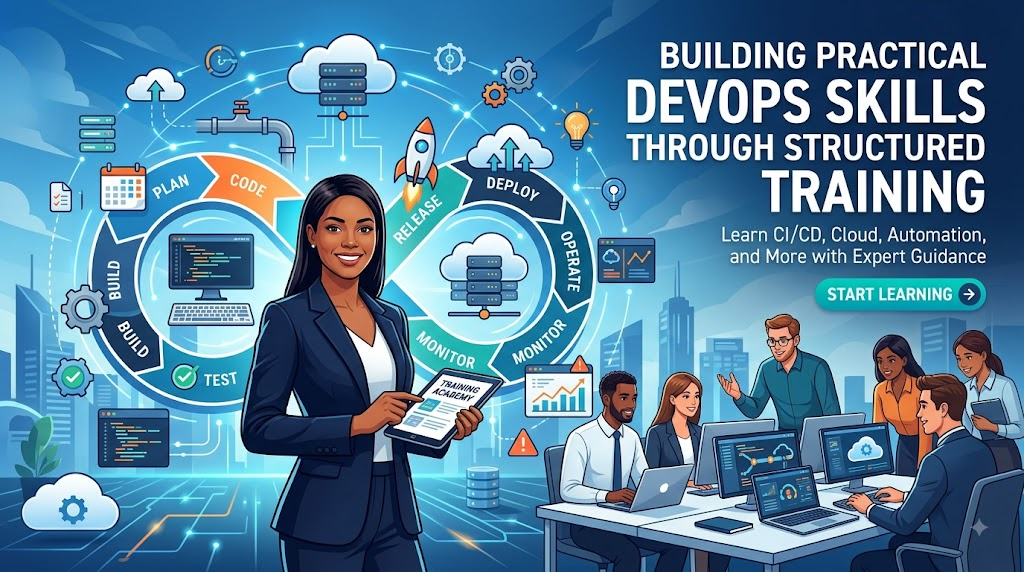
Modern software teams are expected to release applications faster while keeping systems stable, secure, and scalable. As a result, learning DevOps is no longer limited to understanding a few automation tools. Professionals increasingly need practical knowledge of CI/CD, cloud infrastructure, containers, Kubernetes, Infrastructure as Code, security, observability, reliability engineering, and emerging areas such as MLOps.
However, learning these technologies independently can become confusing because every tool solves a different part of the delivery lifecycle. The challenge is not simply learning commands; it is understanding how individual technologies work together in a real production environment.
Structured guidance from an experienced DevOps Trainer can help learners connect concepts with practical implementation. This article explains the skills that matter, common learning challenges, training approaches, real-world applications, and best practices for developing meaningful DevOps capabilities.
Understanding Practical DevOps Learning
DevOps is a combination of technical practices, cultural principles, automation strategies, and collaborative workflows that connect software development with IT operations. Its purpose is to make software delivery more predictable, repeatable, secure, and efficient.
Learning DevOps therefore requires more than becoming familiar with tools such as Git, Jenkins, Docker, Terraform, or Kubernetes. Learners need to understand how code moves from development through testing, deployment, monitoring, and production support.
A useful learning path usually combines Linux administration, networking, version control, scripting, CI/CD, cloud computing, containerization, Infrastructure as Code, security, and observability.
This makes DevOps suitable for developers, system administrators, cloud engineers, operations professionals, testers, technical leads, platform engineers, and organizations trying to modernize their software delivery processes.
Why DevOps Skills Matter in Modern Technology Teams
Modern applications often run across cloud platforms, containers, distributed services, databases, APIs, and automated delivery pipelines. Managing such environments manually can create inconsistency and increase operational complexity.
DevOps practices address these challenges through automation and standardized workflows. CI/CD pipelines can automate testing and deployment, while Infrastructure as Code allows teams to define infrastructure through repeatable configuration.
Container technologies make application environments more consistent, and Kubernetes helps manage containers across distributed infrastructure. Meanwhile, observability enables teams to understand application behavior using metrics, logs, traces, and alerts.
Security is also increasingly integrated into delivery workflows rather than treated as a final-stage activity.
For professionals, learning these practices provides a broader understanding of how modern software platforms are designed, deployed, operated, secured, and improved.
Key Skills and Components to Learn
DevOps Fundamentals
A strong learning journey begins with understanding why DevOps exists.
Learners should understand software development lifecycles, agile delivery, collaboration between teams, automation principles, continuous integration, continuous delivery, configuration management, and operational feedback loops.
Linux is particularly important because many servers, containers, automation platforms, and cloud workloads depend on Linux environments. Basic networking knowledge is equally valuable for understanding DNS, ports, protocols, load balancers, routing, firewalls, and application connectivity.
Instead of immediately jumping between popular tools, learners should first understand the problem each technology is intended to solve. This creates a foundation that makes advanced concepts easier to absorb.
CI/CD and Automation
Continuous integration and continuous delivery are central to practical DevOps environments.
Learners should understand how developers commit code, how automated builds are created, how tests are executed, how artifacts are stored, and how applications move between development, testing, staging, and production environments.
A good CI/CD learning experience should include practical pipeline creation rather than only theoretical explanations.
Students should practice handling failed builds, managing credentials securely, defining deployment conditions, creating rollback strategies, and integrating testing or security checks.
Automation also involves scripting. Basic familiarity with shell scripting or Python can make repetitive administrative tasks easier to automate and troubleshoot.
Cloud Platforms
Cloud platforms have become deeply connected with DevOps practices because they provide programmable infrastructure, managed services, scalability, and automation capabilities.
An AWS DevOps Trainer, for example, may guide learners through cloud infrastructure, compute services, storage, networking, identity management, deployment automation, monitoring, and Infrastructure as Code.
Similarly, an Azure DevOps Trainer can help learners understand Azure infrastructure, pipelines, cloud services, identity, automation, and application deployment workflows.
The goal should not be memorizing every cloud service. Learners benefit more from understanding architectural principles, cost awareness, security controls, scalability, automation, and troubleshooting.
Containers and Kubernetes
Containers allow developers to package applications together with required dependencies, helping maintain consistent environments across development and production.
After understanding Docker or similar container technologies, learners can progress to orchestration.
A Kubernetes Trainer typically helps learners understand pods, deployments, services, namespaces, configuration, secrets, storage, networking, scaling, ingress, health checks, scheduling, and cluster troubleshooting.
Kubernetes can initially appear difficult because it introduces multiple abstractions. Practical exercises are therefore important. Learners should deploy applications, intentionally create failures, inspect logs and events, adjust resource limits, test scaling, and troubleshoot connectivity.
This approach develops operational thinking instead of simple command memorization.
Security and Reliability
DevOps environments increasingly require security and reliability knowledge.
A DevSecOps Trainer may introduce secure pipeline design, vulnerability scanning, dependency analysis, container security, secrets management, access controls, policy enforcement, and security automation.
At the same time, reliability engineering focuses on keeping services available and measurable.
An SRE Trainer can help learners understand service-level indicators, service-level objectives, incident response, monitoring, alerting, capacity planning, error budgets, and post-incident learning.
These concepts teach learners that successful software delivery does not end when an application reaches production. Teams must continuously observe, protect, maintain, and improve the system.
Practical Applications and Real-World Use Cases
DevOps knowledge becomes valuable when learners understand how individual technologies work together.
Consider a SaaS company preparing to release a new application feature. Developers may store their code in Git, while a CI/CD system automatically builds and tests each change.
A container image may then be created and stored in a registry. Infrastructure could be provisioned through Terraform, while Kubernetes manages the application workloads.
The application might run on AWS or Azure, with monitoring systems collecting operational data. Security checks can inspect dependencies and container images before deployment.
If performance problems appear after release, observability tools help engineers investigate the issue.
This example shows why practical learning should focus on complete workflows. Engineers rarely use DevOps technologies in isolation; they use them as interconnected parts of a delivery and operations system.
Common Learning Challenges
One of the biggest challenges in DevOps learning is the number of technologies involved. Beginners may attempt to learn Linux, Git, Jenkins, Docker, Kubernetes, Terraform, AWS, Azure, monitoring, and security simultaneously.
This often creates fragmented understanding.
Another difficulty is insufficient hands-on practice. Watching demonstrations can introduce concepts, but learners usually develop stronger skills when they build environments themselves and troubleshoot failures.
Kubernetes and cloud infrastructure can also introduce architectural complexity. Understanding networking, permissions, storage, identity, and distributed systems takes time.
Learners may additionally focus heavily on successful deployments while overlooking troubleshooting. In professional environments, diagnosing failed pipelines, broken deployments, configuration errors, and performance problems is equally important.
Structured learning should therefore combine concepts, guided implementation, experimentation, and troubleshooting.
How to Choose the Right DevOps Training or Trainer
Selecting training should depend on practical learning needs rather than marketing claims.
An effective trainer should be able to explain not only how tools work but also why teams use them, where they fit within a delivery workflow, and what limitations they have.
Look for training that includes hands-on labs, architecture discussions, deployment exercises, debugging scenarios, automation projects, and practical troubleshooting.
A capable DevOps Trainer in India or elsewhere should also be comfortable explaining related areas such as cloud platforms, containers, CI/CD, Infrastructure as Code, security, and observability.
For remote learners, an Online DevOps Trainer should provide a structured learning environment that encourages interaction, demonstrations, assignments, practical exercises, and questions.
The most useful training usually teaches transferable concepts instead of focusing exclusively on one tool.
Role of a Professional DevOps Trainer
A professional trainer can make complex technologies easier to understand by presenting them in a logical sequence.
Instead of introducing Kubernetes before explaining containers or teaching automated infrastructure before discussing cloud foundations, structured instruction builds concepts gradually.
Different specializations may also require different training approaches.
An AWS DevOps Trainer may emphasize AWS architecture and deployment automation, while an Azure DevOps Trainer focuses on the Azure ecosystem. A Kubernetes Trainer may spend more time on container orchestration and cluster operations.
Likewise, a DevSecOps Trainer focuses on security integration, while an SRE Trainer concentrates on service reliability and operational performance.
An MLOps Trainer extends similar automation principles into machine-learning workflows involving data pipelines, model deployment, monitoring, versioning, and production operations.
The trainer’s role is ultimately to help learners understand connections between technologies rather than merely provide tool demonstrations.
DevOps Training for Different Learner Profiles
Beginners
Beginners should avoid starting with advanced orchestration or complicated production architectures.
A better learning sequence begins with Linux, networking, Git, scripting, software delivery concepts, and basic cloud computing.
Once these foundations are comfortable, learners can progress toward CI/CD, containers, Infrastructure as Code, Kubernetes, monitoring, and security.
Small practical projects are particularly valuable because they help beginners connect concepts without becoming overwhelmed.
Working IT Professionals
Working professionals often already understand part of the technology stack.
System administrators may need stronger automation and cloud skills, while developers may need more infrastructure and operational knowledge.
Their training should therefore focus on closing practical gaps through CI/CD pipelines, cloud provisioning, containers, Kubernetes, monitoring, Infrastructure as Code, and troubleshooting.
Realistic projects usually provide more value than repeating basic theory.
Corporate Teams
Corporate DevOps Training should reflect the organization’s technology environment and engineering goals.
A development team may need CI/CD and container training, while an operations team may require cloud automation, Kubernetes administration, observability, and incident management.
Cross-functional exercises can also help teams understand responsibilities across development, security, operations, and platform engineering.
Corporate training works best when examples reflect realistic workflows instead of disconnected laboratory exercises.
Experienced DevOps Engineers
Experienced engineers often benefit more from advanced topics than introductory tool training.
Useful areas may include Kubernetes architecture, GitOps, policy automation, advanced Infrastructure as Code, platform engineering, DevSecOps, observability, reliability engineering, and MLOps.
They should also practice architecture evaluation, performance optimization, disaster recovery, incident analysis, and troubleshooting complex distributed environments.
Comparing Common DevOps Learning Approaches
| Learning Approach | Best For | Main Advantage | Possible Challenge |
|---|---|---|---|
| Instructor-Led Training | Learners needing guidance | Direct explanation and interaction | Requires scheduled participation |
| Online Training | Remote professionals | Accessible from different locations | Requires consistent participation |
| Corporate Training | Engineering teams | Can align learning with team needs | Requires coordination |
| Self-Learning | Independent learners | Flexible pace and topic selection | Limited direct mentoring |
| Project-Based Learning | Practical learners | Builds hands-on understanding | Requires suitable lab environments |
No single approach works equally well for everyone. Many learners benefit from combining instructor guidance, self-study, documentation reading, and practical projects.
Best Practices for Learning DevOps
- Strengthen Linux and networking fundamentals. Most DevOps environments depend on operating systems, networking, permissions, processes, and services.
- Practice Git regularly. Version control supports collaboration, CI/CD, Infrastructure as Code, and configuration management.
- Build CI/CD pipelines yourself. Creating pipelines helps learners understand build automation, testing, artifact handling, deployment, and failure management.
- Use cloud environments practically. Deploying applications teaches networking, identity, compute, storage, scalability, and security more effectively than theory alone.
- Learn containers before Kubernetes. Understanding images, containers, registries, volumes, and networking makes orchestration concepts easier.
- Practice Infrastructure as Code. Infrastructure automation teaches repeatability, version control, review processes, and standardized environments.
- Study monitoring and observability. Engineers should know how to investigate application and infrastructure behavior after deployment.
- Include security from the beginning. Secrets management, access control, vulnerability scanning, and secure configuration should become normal engineering habits.
- Practice troubleshooting intentionally. Breaking a lab environment and fixing it develops stronger operational skills than repeating successful deployments.
- Build complete projects. Integrating source control, pipelines, containers, cloud infrastructure, Kubernetes, security, and monitoring reveals how DevOps technologies connect.
Future Trends in DevOps Learning
DevOps learning is gradually expanding beyond traditional CI/CD and infrastructure automation.
Platform engineering is gaining attention because organizations want developers to access standardized infrastructure and deployment capabilities without managing every underlying detail.
AI-assisted operations and AIOps can also support areas such as anomaly detection, incident investigation, operational analysis, and automation.
DevSecOps continues to influence how teams integrate security into development pipelines and infrastructure workflows.
SRE principles remain important for organizations operating customer-facing digital services where reliability and measurable service objectives matter.
MLOps is another growing learning area as machine-learning models increasingly require controlled deployment, monitoring, automation, reproducibility, and governance.
These developments do not remove the need for DevOps fundamentals. Instead, they make strong foundations even more valuable.
Frequently Asked Questions
What does a DevOps Trainer teach?
A DevOps Trainer generally teaches concepts such as Linux, Git, CI/CD, automation, cloud computing, containers, Kubernetes, Infrastructure as Code, monitoring, security, and operational practices. The exact curriculum depends on the learner’s experience and training objectives.
Is online DevOps training effective?
Online learning can be effective when it combines live explanations, demonstrations, practical labs, assignments, troubleshooting, and interaction. Learners should still practice independently because DevOps skills are strongly hands-on.
What should I learn before starting DevOps?
Basic familiarity with operating systems, networking, software development concepts, command-line tools, and scripting can be helpful. Beginners can also learn these fundamentals as part of a structured DevOps path.
Is Kubernetes necessary for every DevOps role?
Not every role requires deep Kubernetes expertise. However, Kubernetes knowledge can be valuable for professionals working with cloud-native applications, container platforms, platform engineering, microservices, or modern production infrastructure.
How is DevSecOps different from traditional DevOps?
DevSecOps integrates security practices into development and operational workflows. It may include automated vulnerability checks, secure configuration, secrets management, access control, container security, compliance checks, and security testing within CI/CD pipelines.
What does an MLOps Trainer focus on?
An MLOps Trainer typically focuses on applying automation and operational practices to machine-learning systems. Topics may include model versioning, pipelines, deployment, reproducibility, monitoring, infrastructure, model lifecycle management, and production troubleshooting.
How much practical work should DevOps training include?
Practical work should be a significant part of learning. Learners should build pipelines, provision infrastructure, deploy applications, configure containers, troubleshoot failures, examine monitoring data, and complete integrated projects rather than relying entirely on lectures.
Conclusion
Developing practical DevOps skills requires more than learning a collection of popular tools. Professionals need to understand how development, automation, infrastructure, cloud services, containers, security, monitoring, and reliability practices connect throughout the software lifecycle.
A structured learning path can make this broad technology landscape easier to navigate. Whether someone learns independently, works with an Online DevOps Trainer, participates in Corporate DevOps Training, or studies specialized areas with a Kubernetes, cloud, DevSecOps, SRE, or MLOps trainer, practical implementation should remain the priority.
The most useful approach is simple: build strong fundamentals, practice complete workflows, troubleshoot real problems, and continue extending skills as modern DevOps practices evolve.
Leave a Reply