Mastering Engineering Operations: How to Assess and Scale Reliable Software Teams
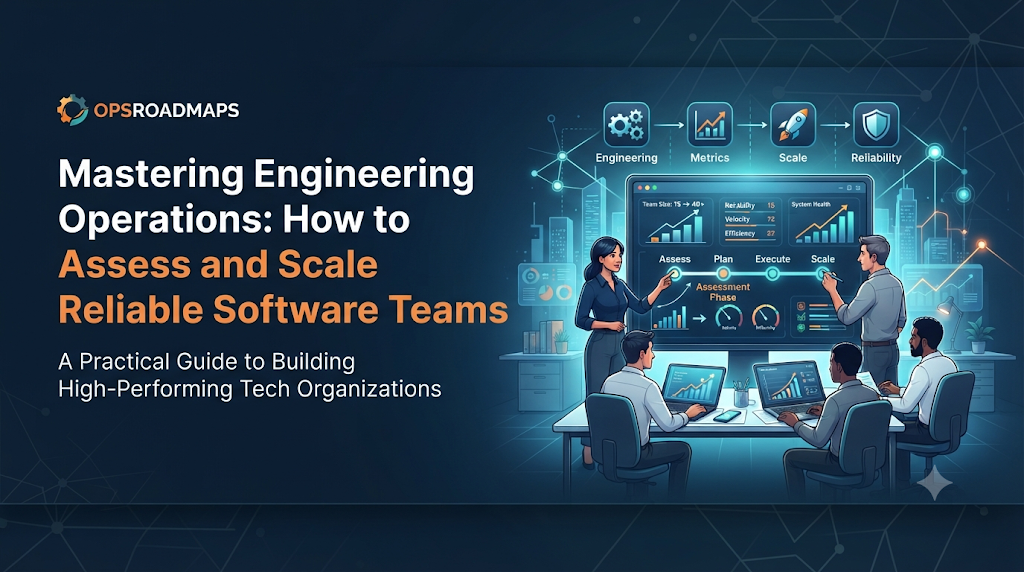
Every high-growth software organization eventually outgrows its informal operating habits. During the early stages, a tight-knit group of engineers can keep the entire system map in their heads, resolve production glitches through shared context, and deploy updates without heavy guardrails. Once customer demand accelerates, traffic multiplies, and new squads form, that same engineering organization can suddenly feel slow, brittle, and hard to steer.
Before approving another hiring spree, migrating to a different cloud provider, or licensing another observability suite, technology leaders should pause and ask five direct questions:
- Can our engineering squads push code to production without creating unnecessary operational risk?
- Are production disruptions investigated down to their root causes, or simply patched over so teams can move on?
- Can developers provision the environments and cloud resources they need without waiting in manual ticket queues?
- Is security built into everyday coding workflows, rather than acting as a last-minute bottleneck before launch?
- Does leadership have a clear picture of what drives cloud spending and why monthly bills keep climbing?
If any of these questions prompt hesitation, vague reassurances, or conflicting answers across different teams, your organization has an operational visibility gap. Closing that gap starts with a structured engineering operations assessment—an objective evaluation of how people, processes, architecture, and tooling work together to ship and operate software reliably.
How Rapid Technical Growth Creates Organizational Drag
Scale rarely breaks an engineering team in a single dramatic collapse. Instead, operational drag accumulates quietly across multiple fronts. A single core application splits into dozens of microservices. A straightforward cloud setup expands into multi-account, multi-region environments. A co-located team evolves into distributed squads working across time zones, each maintaining its own release scripts and conventions.
When friction appears, the default reflex in many companies is to purchase more software. Teams roll out another continuous integration runner, an extra log aggregator, a new secrets vault, or a cloud cost dashboard. Yet adding tools without aligning operational habits often compounds the problem. Every disconnected tool introduces another configuration language, another access model, and another cognitive tax on developers trying to ship product features.
There is a critical distinction between accumulating engineering tools and developing engineering capabilities. A genuine capability exists when any squad can execute an essential operational task—such as rolling back a faulty release, rotating credentials, or isolating a failing service—predictably and without heroic effort. Without evaluating underlying capabilities, leaders often mistake tool procurement for operational progress while foundational gaps widen underneath.
Five Warning Signs That Your Operations Need a Review
You do not need a catastrophic outage to know your engineering operations are under strain. Early warning signs appear in daily workflows long before a major failure makes headlines.
Repeat Production Failures
When the exact same failure patterns keep resurfacing—expired TLS certificates, missing environment variables, exhausted database connection pools, or broken schema migrations—it is not bad luck. Recurring incidents prove that lessons from previous outages are not being converted into automated safeguards.
Uneven Deployment Practices
When one squad ships ten times a day through fully automated pipelines while another relies on manual scripts, late-night release windows, and tribal checklists, operational risk becomes erratic. Inconsistent release mechanics slow down cross-team coordination and turn routine deployments into high-stress events.
Ambiguous Incident Ownership and Communication
During an active outage, confusion over who is leading the response, who is debugging which subsystem, and who is updating stakeholders wastes valuable minutes. When incident roles are unclear, responders either duplicate effort or leave critical components unmonitored while customer impact grows.
Blind Spots in System and Application Behavior
Many organizations ingest massive volumes of logs and server metrics yet still cannot answer basic diagnostic questions during a slowdown. When engineers cannot trace a request across service boundaries or correlate a latency spike with a recent deployment, mean time to resolution stretches from minutes into hours.
Unchecked Cloud Spend Growth
Cloud bills that expand faster than customer usage or revenue are a classic indicator of operational drift. Over-sized compute instances, forgotten staging environments, unattached storage volumes, and inefficient cross-zone data transfers multiply when no team owns the financial impact of its architectural choices.
Left unaddressed, these five warning signs reinforce one another. Delivery velocity drops because engineers spend too much time firefighting. System reliability erodes as shortcuts accumulate in release pipelines. Developer morale suffers under constant context switching, and executive leadership loses confidence in delivery timelines.
Looking Beyond Individual Talent to Evaluate the System
When velocity stalls or outages spike, it is tempting to look for individual execution flaws or assume the organization simply needs more senior hires. In reality, even exceptional engineers placed inside a fragmented operational environment will struggle to deliver reliable results. Operational performance is an emergent property of the entire socio-technical system.
Evaluating that system requires examining how several dimensions interact:
- Workflows and Governance: How changes are reviewed, tested, promoted, and audited without burying developers in bureaucracy.
- System Architecture and Automation: Whether services are designed to degrade gracefully and whether repetitive operational tasks are codified.
- Service Ownership and Documentation: Whether every production service has a clear owning squad and practical runbooks that engineers outside the original team can follow.
- Engineering Culture: Whether developers feel safe surfacing operational risks early and treating incidents as systemic weaknesses rather than personal blame.
Conducting a structured DevOps maturity assessment helps leaders understand how these dimensions reinforce or undermine one another. Rather than grading individual engineers, it measures the maturity of delivery pipelines, environment provisioning, version control habits, and cross-team collaboration—pinpointing where the system itself is holding teams back.
Production Reliability: Can You Truly Trust Your Systems?
Before expanding into new regions, onboarding enterprise clients, or launching high-traffic workloads, engineering leaders must confirm that their production foundation can handle the load. Scaling an unstable environment only multiplies the blast radius of existing vulnerabilities.
Verifying production reliability requires auditing several core safeguards:
- Deployment Safety and Fast Rollbacks: Can updates be rolled out progressively via canary or blue-green strategies, and can a bad release be reverted automatically within minutes?
- Disaster Recovery Preparedness: Are backups validated through regular restoration drills, and can critical services survive an availability zone failure or upstream vendor outage?
- Capacity Planning: Do teams understand throughput limits, auto-scaling thresholds, and database bottlenecks before traffic surges arrive?
- Dependency Mapping and Access Controls: Are failure modes for third-party APIs and internal services documented, and is production access restricted through least-privilege policies rather than shared administrative credentials?
- Clear On-Call Ownership: Is it unmistakably clear which squad holds the pager for every production service and infrastructure layer?
Running a thorough production readiness assessment prior to major launches or infrastructure expansions forces teams to replace assumptions with verified operational controls.
A Practical Lens: What a Kubernetes Environment Reveals
Container orchestration platforms offer a transparent view into an organization’s operational discipline. Many teams adopt Kubernetes expecting built-in resilience, only to discover that operating production workloads safely demands rigorous configuration across dozens of interdependent layers.
Reviewing a cluster against a comprehensive Kubernetes production readiness checklist quickly exposes whether teams have genuinely operationalized their platform or merely containerized legacy habits:
- Cluster Hardening and Network Segmentation: Do containers execute as non-root users with minimal privileges? Are default-deny network policies enforced so a compromised pod cannot freely communicate with internal databases or control planes?
- Workload Configuration and Health Probes: Are liveness, readiness, and startup probes tuned accurately? Misconfigured probes frequently terminate healthy containers prematurely or route live traffic to pods that have not finished initializing.
- Resource Quotas and Limits: Do CPU and memory requests and limits reflect actual runtime behavior? Missing limits allow a single memory-leaking application to starve neighboring workloads on the same node, while overly restrictive limits cause constant CPU throttling.
- Persistent Storage, Telemetry, and Recovery: Are stateful workloads backed by durable storage classes with automated snapshots? Are cluster events, pod logs, and control-plane metrics collected centrally, and has the team rehearsed cluster recovery?
Even everyday debugging tasks reveal deeper organizational habits. Consider Kubernetes CrashLoopBackOff troubleshooting. On the surface, a restarting pod looks like a localized container error. Yet investigating the root cause often uncovers broader operational gaps: hardcoded configuration values failing in a new environment, missing secrets, out-of-memory terminations caused by uncalibrated limits, startup scripts crashing when an upstream database responds slowly, or aggressive liveness probes restarting an application before initialization completes. How rapidly and methodically a team resolves and prevents these loops reflects its true operational maturity.
Post-Incident Reviews: Learning Engine or Mere Recovery?
Every production environment experiences failures. What distinguishes resilient engineering organizations from fragile ones is what happens between service restoration and the next sprint.
Far too many teams confuse recovery with learning. They jump onto an incident call, restart failing containers, roll back a commit, close the ticket, and immediately return to feature development. Two months later, the exact same outage strikes again because the underlying architectural or procedural vulnerability remained untouched.
Evaluating incident practices through an incident management maturity model helps leaders examine the full lifecycle of operational disruptions:
- Automated Detection and Escalation: Do synthetic checks and service-level alerts detect degradations before customers report them, and do escalation paths reach the right responders immediately?
- Structured Command and Updates: Are incident commander and communications roles clearly separated so technical responders can focus on mitigation while stakeholders receive timely updates?
- Blameless Retrospectives: Do teams consistently conduct structured post-incident reviews after significant disruptions, focusing on contributing systemic factors rather than human error?
- Tracked Remediation Work: Do retrospectives produce concrete engineering tickets with assigned owners and deadlines—and are those preventive fixes prioritized alongside product features?
When post-incident reviews become a standard engineering discipline rather than administrative paperwork, every disruption permanently strengthens system resilience.
Making Reliability a Shared Engineering Habit
Establishing a standalone reliability group and expecting it to catch operational issues thrown over the wall by product developers rarely succeeds. When reliability lives in a separate silo, feature squads optimize exclusively for speed while operations engineers burn out trying to stabilize unfamiliar code.
Sustainable reliability requires shared accountability backed by clear, measurable frameworks. Site Reliability Engineering principles give product and engineering teams a shared vocabulary for balancing feature velocity and service stability:
- Service-Level Indicators (SLIs) and Objectives (SLOs): Instead of chasing an unrealistic 100% uptime target, teams track user-centric metrics—such as request latency and availability—and agree on realistic reliability thresholds.
- Error Budgets: The margin between 100% and the agreed SLO acts as an allowable budget for failure over a rolling window. When the error budget is healthy, squads ship features at full pace. When outages or unstable releases deplete the budget, engineering capacity shifts toward stability, testing, and paying down technical debt.
- Toil Reduction: Teams systematically identify and automate repetitive manual maintenance—such as certificate renewals, routine failovers, or manual environment cleanups—so operational overhead does not scale linearly with traffic.
Following a structured SRE adoption roadmap allows organizations to phase in these practices sensibly. Teams can begin by defining SLIs and SLOs for critical customer journeys, agreeing on error budget policies with product leadership, and steadily automating high-toil operational workflows.
Aligning Security with Developer Productivity
In many organizations, security is still experienced as a final gate—a manual sign-off, a compliance spreadsheet, or a last-minute audit days before release. When security enters the picture at the end of the lifecycle, every vulnerability becomes an emergency, creating friction between security teams and developers.
Security and developer velocity improve together when guardrails are embedded directly into everyday pipelines. Rather than asking developers to memorize dense security policies, teams should make the secure path the default path:
- Automated Code and Dependency Scanning: Static analysis and software composition checks run automatically on every pull request, flagging vulnerable packages and common coding flaws while the context is still fresh.
- Automated Secrets Hygiene: Dynamic, short-lived credentials and centralized secrets managers eliminate hardcoded API keys in repositories and configuration files.
- Container Image and Infrastructure Policy Checks: Base images are scanned continuously for known vulnerabilities, while policy-as-code rules validate infrastructure definitions before cloud resources are provisioned.
- Verified Build Pipelines: Signed artifacts and provenance checks ensure only verified builds reach production.
A well-sequenced DevSecOps implementation roadmap helps teams introduce these safeguards incrementally—starting with high-signal guardrails like secret scanning and dependency alerts before advancing to automated policy enforcement and supply-chain verification—so security strengthens delivery confidence without slowing daily commits.
Why Modern Infrastructure Alone Does Not Eliminate Developer Friction
Upgrading cloud infrastructure does not automatically translate into higher developer productivity. Many organizations invest heavily in Kubernetes clusters, infrastructure-as-code repositories, and cloud-native services, yet developers still wait days for staging environments, copy-paste massive configuration files, or submit tickets for routine database access.
When infrastructure complexity outpaces developer usability, teams suffer from high cognitive load. Application engineers end up acting as part-time infrastructure administrators just to deploy a microservice or wire up basic telemetry.
High-performing organizations solve this by treating internal infrastructure as a product built for developers:
- Self-Service Provisioning and Golden Paths: Developers launch compliant environments, databases, and CI/CD pipelines using standardized templates that include observability, security defaults, and scaling rules out of the box.
- Internal Developer Platforms (IDPs): A cohesive developer layer abstracts away underlying infrastructure mechanics while still allowing teams to customize configurations when needed.
- Product-Minded Platform Teams: Platform engineers focus on building reliable, well-documented self-service capabilities and measuring internal adoption rather than acting as a ticket-driven support queue.
A deliberate platform engineering adoption roadmap keeps platform initiatives anchored in genuine developer pain points rather than speculative tooling projects, ensuring internal capabilities actually get adopted.
Are Your Teams Seeing the Signals That Matter?
Collecting telemetry is easy; turning that data into timely operational decisions is much harder. Many companies pay substantial sums to ingest terabytes of logs, metrics, and traces every day, yet responders still struggle to isolate the root cause of production slowdowns.
The gap usually comes down to signal clarity and context. Dashboards cluttered with hundreds of low-level infrastructure graphs overwhelm engineers during an incident, while noisy, poorly tuned alerts trigger alert fatigue that trains on-call teams to ignore notifications.
Evaluating telemetry practices through an observability maturity model encourages leaders to look beyond raw data volume and measure actual diagnostic speed:
- Consistent Telemetry and Context: Are logs structured uniformly, and do services propagate correlation IDs across asynchronous queues and internal API calls?
- Service-Level Visibility: Do primary dashboards highlight user-facing symptoms and SLO burn rates rather than just CPU and memory utilization?
- High-Signal Alerting: Does every paging alert represent an urgent, customer-impacting issue backed by a clear runbook, while non-urgent anomalies route to low-priority channels?
- End-to-End Distributed Tracing: Can an on-call engineer follow a slow transaction across microservices, caches, and databases to pinpoint the bottleneck within minutes?
Mature observability transforms debugging from guesswork into rapid, evidence-based investigation.
Connecting Infrastructure Choices to Cloud Economics
Every architectural decision carries a financial footprint, yet developers frequently deploy and scale systems with minimal visibility into cloud billing. When cloud invoices are reviewed only by finance teams at month-end, cost control becomes a reactive exercise rather than an ongoing engineering discipline.
Operational inefficiencies routinely hide in familiar places across cloud accounts:
- Idle and Orphaned Assets: Unattached block storage volumes, unused load balancers, stale snapshots, and forgotten development environments running continuously.
- Over-Provisioned Compute and Rigid Scaling: Instances sized for peak seasonal traffic sitting at 10% utilization year-round, or auto-scaling rules that scale out rapidly without scaling back down.
- Storage Retention and Data Transfer Blind Spots: Unmanaged log retention policies and unoptimized cross-availability-zone traffic patterns that quietly inflate monthly bills.
- Missing Cost Attribution: Shared clusters and untagged resources that prevent leaders from mapping cloud spending to specific products, teams, or environments.
Executing a structured cloud cost optimization roadmap connects operational telemetry directly to financial accountability. By enforcing tagging standards, rightsizing workloads based on real usage data, automating off-hours shutdowns for non-production environments, and giving squads visibility into their own unit costs, organizations eliminate waste without sacrificing reliability, security, or performance.
Connecting Operational Improvements Instead of Running Siloed Projects
When engineering leaders identify multiple operational gaps, a common mistake is launching half a dozen disconnected improvement initiatives at once. One group upgrades CI/CD pipelines, another starts an SRE pilot, security rolls out new compliance scanners, platform engineers build golden templates, and finance launches a cloud cost-reduction drive.
In practice, these disciplines depend heavily on one another:
- Meaningful SRE error budgets cannot operate without accurate observability signals to measure SLIs reliably.
- Self-service platform engineering templates fall short if DevSecOps guardrails and FinOps tagging standards are missing from the baseline workflows.
- Smooth incident management depends on standardized DevOps deployment automation to roll back faulty changes safely.
Running these tracks in isolation creates duplicated effort, competing priorities, and change fatigue across engineering squads. Sequencing matters. When several operational gaps exist simultaneously, leaders need a unified view of how foundational capabilities enable more advanced practices—ensuring teams build the right prerequisites first rather than layering complex practices onto fragile basics.
Turning Assessment Findings into Decisions Teams Can Execute
Uncovering operational weaknesses only creates value if it leads to focused, sustained follow-through. Too often, internal reviews produce sprawling spreadsheets or slide decks that sit untouched once daily sprint pressures return. Moving from diagnosis to real execution requires a structured path:
- Establish an Objective Baseline: Measure current practices across teams using consistent criteria rather than relying on anecdotal impressions.
- Ground Findings in Clear Evidence: Tie every identified gap to concrete operational standards so engineers understand why a practice matters, not just that a score is low.
- Separate Critical Risks from Efficiency Gains: Address urgent production vulnerabilities—such as untested disaster recovery or exposed secrets—before tackling longer-term optimizations.
- Prioritize by Impact and Effort: Focus first on high-leverage improvements that remove immediate operational friction and unlock downstream capabilities.
- Assign Clear Ownership and Timelines: Integrate operational improvements into regular team roadmaps with clear accountability rather than treating them as unpaid side work.
- Track Progress Through Measurable Indicators: Monitor tangible shifts—such as deployment frequency, change failure rate, recovery times, and alert volume—to verify that changes are working.
- Reassess as Engineering Practices Evolve: Repeat evaluations periodically as architectures scale, teams reorganize, and business demands shift.
This is where OpsRoadmaps provides practical structure for engineering organizations. Built as an engineering operations assessment and improvement planning platform, OpsRoadmaps helps engineering managers, DevOps teams, SREs, platform engineers, cloud architects, security professionals, and technology leaders connect operational evaluation directly to execution. Spanning 42 engineering operations disciplines across nine core domains, the platform enables teams to run structured self-assessments that generate explainable maturity scoring, prioritized findings, and dependency-aware improvement roadmaps.
Because every score is derived from clearly defined assessment criteria rather than opaque black-box ratings, teams can trace each recommendation back to specific operational practices and understand the reasoning behind prioritized actions. At the same time, leaders should view self-assessment results for what they truly are: an internal decision-support baseline anchored in defined operational standards, rather than an independent third-party audit, regulatory compliance certification, or blanket guarantee of production readiness. Combined with disciplined engineering execution, that transparency helps organizations make smarter trade-offs and sequence improvements with confidence.
Building Engineering Maturity Through Continuous Decisions
Operational maturity is never achieved through a single assessment, a one-off tool migration, or an isolated certification exercise. Software systems evolve continuously, new engineers join, product requirements shift, and infrastructure architectures grow more complex with every stage of business growth.
Stronger, more reliable engineering organizations are built through hundreds of consistent, well-informed decisions made over time—choosing to fix the root cause of a recurring outage instead of applying a temporary patch, embedding security and cost visibility into standard templates, and giving teams clear ownership over the systems they build and run. By combining regular, transparent evaluation with shared accountability and structured improvement planning, platforms like OpsRoadmaps help engineering leaders move beyond reactive firefighting and build operations that scale alongside their business.
Leave a Reply