The Delivery Engine: Modernizing Platform Engineering and DevOps Consulting in the Netherlands
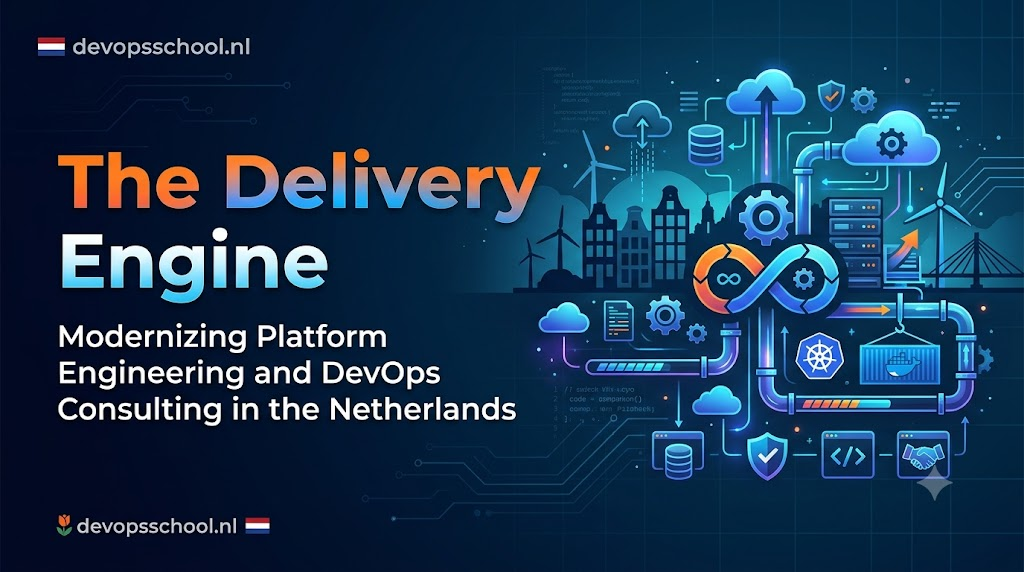
Every growing technology company eventually discovers that writing software and shipping software are two completely different problems. Early on, an engineer pushes a branch, an automated check completes, and the update is serving users within minutes. But as teams expand, that once-frictionless path thickens with operational drag. Staging environments fall out of alignment, integration test suites slow down, and shipping a feature turns into a fraught, multi-hour coordination meeting. As the engineering advisory team at devopsschool.nl consistently observes in modern software operations, these slowdowns are rarely caused by a failure of developer talent; they are the natural consequence of an unengineered delivery pipeline.
For software organizations across the Netherlands, this friction carries high operational stakes. Technology hubs spanning Amsterdam, Rotterdam, Utrecht, and Eindhoven operate in an intensely competitive environment governed by strict European standards like NIS2 and the Digital Operational Resilience Act. In this regulatory climate, informal deployment practices and fragile architectures represent serious business liabilities.
When organizations attempt to fix delivery lag by applying more ad-hoc scripts or inserting additional layers of administrative approval, operational fragility only multiplies. Restoring development velocity requires treating the internal software delivery path as an engineered product. Bringing in dedicated DevOps consulting in the Netherlands gives engineering leaders the outside clarity, architectural patterns, and practical team enablement needed to turn volatile release schedules into calm, dependable automation.
Diagnosing the Realities of Dutch Cloud Infrastructure
Operating modern distributed systems in the Dutch market entails a unique combination of high uptime expectations, strict regional data governance policies, and an ultra-competitive recruitment environment for senior systems architects. On the ground, tech organizations typically struggle against three structural bottlenecks:
- Frictional Handoffs Between Engineering Units: When software developers write code in an isolated environment and depend on a separate infrastructure unit to configure networking routes, provision storage, or manage permissions, delivery queues stall. Minor configuration changes languish in ticket backlogs, turning straightforward updates into multi-week efforts.
- The Telemetry Deficit in Microservices: Decomposing large applications into microservices provides modularity, but it multiplies operational complexity. When an edge gateway experiences elevated latency, diagnosing whether the issue stems from an upstream queue, a congested database pool, or an exhausted container memory limit requires hours of manual log parsing without unified distributed tracing.
- Unmonitored Cloud Resource Creep: The flexibility of public cloud platforms makes launching new compute instances trivial. However, without automated policies, abandoned staging clusters, orphaned storage disks, and over-provisioned nodes quietly consume infrastructure budgets, triggering abrupt friction between engineering leadership and finance teams.
Overcoming these bottlenecks requires moving past patchwork solutions and establishing a reliable, automated platform standard.
Four Foundations of a Sustainable Delivery Platform
A disciplined technical consulting engagement looks beyond superficial changes. Instead, it systematically addresses failure modes across four essential platform disciplines:
1. Self-Service Developer Platforms and GitOps Workflows
When developers have to wait for system administrators to open firewall ports, provision database instances, or create testing sandboxes, release momentum evaporates. Modern platform engineering solves this by delivering an internal developer platform operated through GitOps principles.
Declarative definitions manage the intended state of all infrastructure components directly within version-controlled repositories. Software developers can independently launch pre-approved, ephemeral preview environments through everyday pull requests. Meanwhile, platform and systems engineers define security policies, access boundaries, and spending guardrails behind the scenes, ensuring safety without introducing human gatekeeping.
2. Production-Grade Kubernetes Orchestration
While containerizing an application is simple, maintaining robust Kubernetes clusters under real-world traffic spikes requires deep operational expertise.
Specialized consultants help teams eliminate fragile cluster configurations. They set up dynamic pod autoscaling based on genuine workload metrics, implement zero-downtime rolling updates, and configure service meshes to handle mutual TLS encryption between microservices. These refinements ensure systems automatically handle fluctuating traffic without requiring emergency administrative intervention.
3. Shifting Security Left via DevSecOps
Treating security as a final pre-release inspection gate creates tension between developers and compliance officers, leading to last-minute delays. DevSecOps restructures this balance by embedding automated security checkpoints directly into continuous integration workflows.
Automated pipelines inspect code for exposed credentials, scan third-party libraries against known vulnerability databases, and validate container baselines before images reach production registries. This surfaces security risks early in development when they are easiest to resolve, satisfying European regulatory standards without slowing release cadence.
4. Real Reliability Through SRE and Observability
Relying on basic infrastructure alerts, such as high server memory notifications, often warns teams long after users have experienced degraded service. Site Reliability Engineering shifts the monitoring focus directly to the user experience.
Teams establish Service Level Indicators and Service Level Objectives to quantify application health based on response times and request success rates. Paired with distributed tracing, engineers can trace user journeys across dynamic container clusters to isolate performance bottlenecks and resolve production issues before they cause widespread outages.
A Step-by-Step Trajectory for Platform Transformation
Modernizing a delivery workflow should never involve an all-or-nothing system freeze. The most dependable transformations follow clear, manageable stages:
- Stage 1: Discovery and Process Auditing: The journey begins by tracing how an idea moves from an approved commit to production. Reviewing deployment intervals, recovery times, and developer frustrations highlights where manual interventions slow down delivery.
- Stage 2: Infrastructure as Code and Environment Parity: Manual server adjustments are systematically replaced with declarative, modular infrastructure templates. Reusable modules guarantee that testing, staging, and production environments remain completely identical, eliminating configuration drift.
- Stage 3: Platform Self-Service and Security Checks: Automated container vulnerability scans, dependency audits, and GitOps workflows are layered into everyday developer actions. Feature teams gain the freedom to deploy to isolated testing environments independently.
- Stage 4: Observability and Incident Readiness: Teams deploy centralized tracing and telemetry dashboards, establish actionable on-call runbooks, and conduct controlled failure simulations to verify the platform handles unexpected node failures smoothly.
Why Engineering Culture Outweighs Tool Selection
Adopting advanced cloud-native tools without addressing team dynamics rarely fixes broken delivery cycles. Tools merely accelerate existing engineering habits; if communication is fractured, automation simply deploys errors faster.
Sustainable platform adoption rests on three organizational principles:
- Treating Platforms as Internal Products: Platform engineers must treat internal software developers as their primary customers. The platform should be intuitive, robustly documented, and maintained to encourage natural voluntary adoption over shadow operations.
- Blameless Operational Reviews: System incidents are unavoidable in complex distributed environments. Conducting blameless post-mortems shifts the focus from individual culpability toward systemic and architectural design flaws, encouraging developers to speak candidly about production risks.
- Prioritizing Knowledge Transfer: Outside advisory should never create ongoing external dependencies. The core objective of any consulting engagement is upskilling permanent engineering staff so they possess the confidence and expertise to operate, troubleshoot, and evolve the platform independently.
Managing Monolith Modernization and Cloud Economics
Two common obstacles often complicate digital modernization projects: handling legacy software components and managing ongoing cloud expenditures.
Incremental Modernization with the Strangler Fig Pattern
Attempting to rewrite an established monolithic application from scratch is one of the riskiest endeavors an engineering team can undertake. A proven, lower-risk alternative is the Strangler Fig pattern.
By deploying an intelligent routing proxy in front of the existing system, engineers can incrementally carve out bounded domain contexts into independent, containerized services. The core legacy platform continues supporting revenue operations while new features take full advantage of modern platform automation.
Integrating FinOps into Continuous Delivery
Moving systems to public cloud environments without automated fiscal controls frequently leads to runaway hosting costs. Integrating FinOps practices into standard delivery workflows prevents budgetary surprises.
Automated cost-estimation checks run directly inside pull requests, giving engineers real-time visibility into the financial impact of their infrastructure changes before resources are provisioned. Paired with dynamic autoscaling and the automatic shutdown of non-production environments during off-hours, organizations keep cloud investments tightly aligned with actual usage.
Building Sustainable Capabilities with DevOpsSchool.nl
Adopting advanced cloud automation, container management, and continuous security requires practical skills across the entire engineering department. Even the most carefully designed cloud platform will sit underutilized if developers find the deployment tooling confusing or difficult to navigate.
Building this internal confidence is where specialized knowledge partners provide significant leverage. Organizations like DevOpsSchool.nl support teams through this transformation by combining strategic engineering guidance with focused corporate training across the Netherlands.
Whether a company needs expert help architecting a Kubernetes environment, guidance on cloud migration and Site Reliability Engineering, or hands-on team workshops covering container operations and security automation, combining practical advisory with direct skill-building ensures internal engineers are fully equipped to run resilient systems autonomously.
Frequently Asked Questions
How does an external DevOps consultancy differ from traditional engineering staff augmentation?
Staff augmentation typically places individual contractors into an existing team to clear specific backlog items. A DevOps consultancy takes a broader architectural approach, examining the organization’s entire development lifecycle. Advisors identify procedural bottlenecks, introduce automated platform standards, and train in-house engineers to build durable operational independence.
What metrics best capture the health of a software delivery platform?
The most reliable framework for measuring delivery efficiency is the DORA model:
- Deployment Frequency: How often code is successfully delivered to production.
- Lead Time for Changes: The duration required for committed code to become operational in production.
- Change Failure Rate: The percentage of production releases requiring hotfixes or immediate rollbacks.
- Recovery Time: The time needed to restore operational stability following an unexpected outage.
Can on-premise or hybrid architectures benefit from modern DevOps practices?
Yes. DevOps principles are independent of physical hosting models. Automated continuous integration, declarative configuration management, repeatable container builds, and structured observability frameworks deliver immediate value to on-premise hardware and virtual machines while laying the technical groundwork for future cloud initiatives.
Sustaining Engineering Velocity
Modern software delivery is ultimately defined by stability, predictability, and repeatability. When infrastructure deployments are automated, auditable, and monitored through clear telemetry, engineering teams can release updates with confidence rather than anxiety.
Moving away from brittle, manual interventions toward an automated developer platform requires deliberate planning, modern platform tooling, and an ongoing investment in engineering skills. By eliminating architectural bottlenecks, automating security gates, and upskilling in-house developers, organizations establish an operational foundation built for long-term digital growth.
Leave a Reply